

What Is The Makeup Of The Atmosphere And Air Pressure
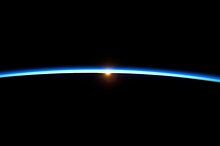
NASA photo showing Globe'southward atmosphere at sunset, with Earth silhouetted
Blueish calorie-free is scattered more than other wavelengths by the gases in the atmosphere, surrounding Earth in a visibly blueish layer when seen from space on board the ISS at an altitude of 335 km (208 mi).[1]

Composition of Earth'south atmosphere past molecular count, excluding h2o vapor. Lower pie represents trace gases that together compose about 0.0434% of the atmosphere (0.0442% at August 2021 concentrations[two] [iii]). Numbers are mainly from 2000, with CO2 and methane from 2019, and do not represent any single source.[4]
The atmosphere of Globe, commonly known as air, is the layer of gases retained by Earth's gravity that surrounds the planet and forms its planetary atmosphere. The atmosphere of Earth protects life on World past creating pressure level assuasive for liquid h2o to exist on the Earth'due south surface, absorbing ultraviolet solar radiation, warming the surface through estrus retention (greenhouse effect), and reducing temperature extremes between day and night (the diurnal temperature variation).
By mole fraction (i.e., by number of molecules), dry air contains 78.08% nitrogen, 20.95% oxygen, 0.93% argon, 0.04% carbon dioxide, and small amounts of other gases.[8] Air likewise contains a variable amount of water vapor, on average effectually 1% at sea level, and 0.4% over the entire atmosphere. Air composition, temperature, and atmospheric pressure vary with altitude. Within the atmosphere, air suitable for use in photosynthesis by terrestrial plants and breathing of terrestrial animals is constitute only in Earth'southward troposphere.[ citation needed ]
World's early temper consisted of gases in the solar nebula, primarily hydrogen. The atmosphere changed significantly over time, affected by many factors such as volcanism, life, and weathering. Recently, human activity has likewise contributed to atmospheric changes, such as global warming, ozone depletion and acid deposition.
The atmosphere has a mass of nearly 5.15×ten xviii kg,[nine] iii quarters of which is inside about 11 km (6.8 mi; 36,000 ft) of the surface. The atmosphere becomes thinner with increasing altitude, with no definite boundary between the atmosphere and outer space. The Kármán line, at 100 km (62 mi) or 1.57% of Earth's radius, is often used as the edge betwixt the atmosphere and outer space. Atmospheric effects go noticeable during atmospheric reentry of spacecraft at an altitude of around 120 km (75 mi). Several layers can exist distinguished in the atmosphere, based on characteristics such every bit temperature and composition.
The written report of Earth's temper and its processes is called atmospheric scientific discipline (aerology), and includes multiple subfields, such as climatology and atmospheric physics. Early pioneers in the field include Léon Teisserenc de Bort and Richard Assmann.[10] The study of historic atmosphere is called paleoclimatology.
Composition

Mean atmospheric h2o vapor
The three major constituents of Earth's atmosphere are nitrogen, oxygen, and argon. Water vapor accounts for roughly 0.25% of the atmosphere by mass. The concentration of water vapor (a greenhouse gas) varies significantly from around 10 ppm by mole fraction in the coldest portions of the atmosphere to equally much as 5% by mole fraction in hot, humid air masses, and concentrations of other atmospheric gases are typically quoted in terms of dry air (without water vapor).[eleven] : 8 The remaining gases are ofttimes referred to equally trace gases,[12] amid which are other greenhouse gases, principally carbon dioxide, methyl hydride, nitrous oxide, and ozone. Besides argon, already mentioned, other noble gases, neon, helium, krypton, and xenon are also present. Filtered air includes trace amounts of many other chemical compounds. Many substances of natural origin may be present in locally and seasonally variable small-scale amounts as aerosols in an unfiltered air sample, including dust of mineral and organic composition, pollen and spores, ocean spray, and volcanic ash. Various industrial pollutants likewise may exist present every bit gases or aerosols, such as chlorine (elemental or in compounds), fluorine compounds and elemental mercury vapor. Sulfur compounds such as hydrogen sulfide and sulfur dioxide (SOtwo) may exist derived from natural sources or from industrial air pollution.
| Gas | Mole fraction (A) | ||
|---|---|---|---|
| Name | Formula | in ppm (B) | in % |
| Nitrogen | North2 | 780,840 | 78.084 |
| Oxygen | O2 | 209,460 | 20.946 |
| Argon | Ar | ix,340 | 0.9340 |
| Carbon dioxide (Apr, 2022)(C) [thirteen] | CO2 | 417 | 0.0417 |
| Neon | Ne | 18.18 | 0.001818 |
| Helium | He | 5.24 | 0.000524 |
| Marsh gas | CH4 | one.87 | 0.000187 |
| Krypton | Kr | i.14 | 0.000114 |
| Not included in above dry out atmosphere: | |||
| Water vapor(D) | HtwoO | 0–30,000(D) | 0–3%(Eastward) |
notes:
| |||
The boilerplate molecular weight of dry air, which can be used to calculate densities or to catechumen between mole fraction and mass fraction, is near 28.946[14] or 28.96[xv] [16] g/mol. This is decreased when the air is humid.
The relative concentration of gases remains abiding until about 10,000 one thousand (33,000 ft).[17]

The mole fraction of the main constituents of the World's atmosphere equally a part of height according to the MSIS-East-90 atmospheric model.
Stratification

Earth's atmosphere Lower four layers of the temper in iii dimensions as seen diagonally from above the exobase. Layers drawn to calibration, objects within the layers are not to scale. Aurorae shown hither at the bottom of the thermosphere tin actually form at any altitude in this atmospheric layer.
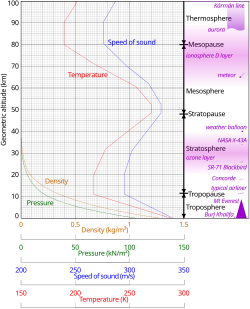
[18]In full general, air pressure level and density subtract with altitude in the temper. However, the temperature has a more complicated profile with altitude, and may remain relatively constant or even increase with altitude in some regions (meet the temperature section, below). Because the general pattern of the temperature/altitude contour, or lapse rate, is constant and measurable by ways of instrumented balloon soundings, the temperature behavior provides a useful metric to distinguish atmospheric layers. In this way, Earth's atmosphere can be divided (called atmospheric stratification) into five main layers: troposphere, stratosphere, mesosphere, thermosphere, and exosphere.[19] The altitudes of the five layers are as follows:
- Exosphere: 700 to ten,000 km (440 to 6,200 miles)[20]
- Thermosphere: 80 to 700 km (l to 440 miles)[21]
- Mesosphere: 50 to fourscore km (31 to 50 miles)
- Stratosphere: 12 to fifty km (7 to 31 miles)
- Troposphere: 0 to 12 km (0 to seven miles)[22]
Exosphere
The exosphere is the outermost layer of World's temper (i.e. the upper limit of the temper). It extends from the thermopause, at the top of the thermosphere at an distance of about 700 km in a higher place bounding main level, to about 10,000 km (six,200 mi; 33,000,000 ft), where information technology merges into the solar air current.[xx]
This layer is mainly composed of extremely low densities of hydrogen, helium and several heavier molecules including nitrogen, oxygen and carbon dioxide closer to the exobase. The atoms and molecules are so far apart that they tin can travel hundreds of kilometers without colliding with one some other. Thus, the exosphere no longer behaves like a gas, and the particles constantly escape into space. These free-moving particles follow ballistic trajectories and may migrate in and out of the magnetosphere or the solar wind.
The exosphere is too far in a higher place World for meteorological phenomena to be possible. However, Earth's auroras—the aurora borealis (northern lights) and aurora australis (southern lights)—sometimes occur in the lower part of the exosphere, where they overlap into the thermosphere. The exosphere contains many of the bogus satellites that orbit Globe.
Thermosphere
The thermosphere is the 2nd-highest layer of Earth'due south atmosphere. It extends from the mesopause (which separates it from the mesosphere) at an altitude of virtually 80 km (50 mi; 260,000 ft) upwards to the thermopause at an altitude range of 500–thou km (310–620 mi; 1,600,000–3,300,000 ft). The meridian of the thermopause varies considerably due to changes in solar activity.[21] Considering the thermopause lies at the lower boundary of the exosphere, it is likewise referred to as the exobase. The lower function of the thermosphere, from 80 to 550 kilometres (l to 342 mi) above Earth'southward surface, contains the ionosphere.
The temperature of the thermosphere gradually increases with height and can rise as high equally 1500 °C (2700 °F), though the gas molecules are so far apart that its temperature in the usual sense is non very meaningful. The air is and then rarefied that an individual molecule (of oxygen, for example) travels an boilerplate of 1 kilometre (0.62 mi; 3300 ft) between collisions with other molecules.[23] Although the thermosphere has a loftier proportion of molecules with high free energy, it would not feel hot to a man in straight contact, because its density is too low to conduct a pregnant amount of energy to or from the pare.
This layer is completely cloudless and gratis of water vapor. However, non-hydrometeorological phenomena such as the aurora borealis and aurora australis are occasionally seen in the thermosphere. The International Space Station orbits in this layer, between 350 and 420 km (220 and 260 mi). It is this layer where many of the satellites orbiting the earth are present.
Mesosphere
The mesosphere is the third highest layer of Earth's temper, occupying the region above the stratosphere and below the thermosphere. It extends from the stratopause at an altitude of well-nigh 50 km (31 mi; 160,000 ft) to the mesopause at eighty–85 km (50–53 mi; 260,000–280,000 ft) above sea level.
Temperatures drop with increasing altitude to the mesopause that marks the top of this middle layer of the atmosphere. It is the coldest identify on Earth and has an boilerplate temperature effectually −85 °C (−120 °F; 190 Chiliad).[24] [25]
Just below the mesopause, the air is so cold that even the very deficient water vapor at this altitude tin can sublimate into polar-mesospheric noctilucent clouds of ice particles. These are the highest clouds in the temper and may be visible to the naked heart if sunlight reflects off them about an hour or two afterward dusk or similarly earlier sunrise. They are near readily visible when the Sun is around 4 to 16 degrees below the horizon. Lightning-induced discharges known equally transient luminous events (TLEs) occasionally grade in the mesosphere above tropospheric thunderclouds. The mesosphere is also the layer where most meteors burn down up upon atmospheric entrance. Information technology is as well high above Earth to exist attainable to jet-powered shipping and balloons, and too low to permit orbital spacecraft. The mesosphere is mainly accessed by sounding rockets and rocket-powered aircraft.
Stratosphere
The stratosphere is the second-everyman layer of Earth'southward atmosphere. Information technology lies above the troposphere and is separated from information technology past the tropopause. This layer extends from the superlative of the troposphere at roughly 12 km (7.5 mi; 39,000 ft) in a higher place World'south surface to the stratopause at an altitude of about 50 to 55 km (31 to 34 mi; 164,000 to 180,000 ft).
The atmospheric pressure level at the top of the stratosphere is roughly 1/1000 the pressure at sea level. It contains the ozone layer, which is the part of Earth's temper that contains relatively high concentrations of that gas. The stratosphere defines a layer in which temperatures ascent with increasing distance. This ascension in temperature is caused past the absorption of ultraviolet radiation (UV) radiation from the Lord's day past the ozone layer, which restricts turbulence and mixing. Although the temperature may be −threescore °C (−76 °F; 210 1000) at the tropopause, the meridian of the stratosphere is much warmer, and may be nigh 0 °C.[26]
The stratospheric temperature contour creates very stable atmospheric conditions, and so the stratosphere lacks the conditions-producing air turbulence that is so prevalent in the troposphere. Consequently, the stratosphere is almost completely gratuitous of clouds and other forms of conditions. Still, polar stratospheric or nacreous clouds are occasionally seen in the lower part of this layer of the atmosphere where the air is coldest. The stratosphere is the highest layer that can exist accessed by jet-powered aircraft.
Troposphere
The troposphere is the lowest layer of Earth'south temper. It extends from Earth's surface to an average height of near 12 km (7.five mi; 39,000 ft), although this altitude varies from about nine km (five.six mi; thirty,000 ft) at the geographic poles to 17 km (11 mi; 56,000 ft) at the Equator,[22] with some variation due to weather. The troposphere is bounded higher up past the tropopause, a boundary marked in most places by a temperature inversion (i.e. a layer of relatively warm air above a colder 1), and in others by a zone that is isothermal with height.[27] [28]
Although variations do occur, the temperature usually declines with increasing distance in the troposphere considering the troposphere is by and large heated through energy transfer from the surface. Thus, the lowest function of the troposphere (i.e. Earth'southward surface) is typically the warmest section of the troposphere. This promotes vertical mixing (hence, the origin of its name in the Greek word τρόπος, tropos, significant "turn"). The troposphere contains roughly 80% of the mass of Earth'southward atmosphere.[29] The troposphere is denser than all its overlying layers considering a larger atmospheric weight sits on summit of the troposphere and causes it to be most severely compressed. Fifty pct of the total mass of the temper is located in the lower v.6 km (3.5 mi; 18,000 ft) of the troposphere.
Well-nigh all atmospheric water vapor or wet is found in the troposphere, so it is the layer where most of Earth's atmospheric condition takes place. It has basically all the weather condition-associated cloud genus types generated by active wind circulation, although very alpine cumulonimbus thunder clouds can penetrate the tropopause from below and ascension into the lower function of the stratosphere. Most conventional aviation activity takes place in the troposphere, and it is the but layer that tin be accessed past propeller-driven shipping.

Infinite Shuttle Endeavour orbiting in the thermosphere. Because of the angle of the photo, it appears to straddle the stratosphere and mesosphere that really lie more than than 250 km (160 mi) below. The orangish layer is the troposphere, which gives way to the whitish stratosphere and so the blue mesosphere.[30]
Other layers
Within the v principal layers above, which are largely determined by temperature, several secondary layers may be distinguished by other properties:
- The ozone layer is contained within the stratosphere. In this layer ozone concentrations are about ii to viii parts per million, which is much higher than in the lower temper but all the same very small compared to the main components of the atmosphere. It is mainly located in the lower portion of the stratosphere from virtually xv–35 km (ix.3–21.7 mi; 49,000–115,000 ft), though the thickness varies seasonally and geographically. About xc% of the ozone in Earth'southward atmosphere is contained in the stratosphere.
- The ionosphere is a region of the atmosphere that is ionized by solar radiations. It is responsible for auroras. During daytime hours, it stretches from 50 to 1,000 km (31 to 621 mi; 160,000 to 3,280,000 ft) and includes the mesosphere, thermosphere, and parts of the exosphere. However, ionization in the mesosphere largely ceases during the nighttime, so auroras are ordinarily seen only in the thermosphere and lower exosphere. The ionosphere forms the inner edge of the magnetosphere. It has practical importance considering information technology influences, for example, radio propagation on Earth.
- The homosphere and heterosphere are divers by whether the atmospheric gases are well mixed. The surface-based homosphere includes the troposphere, stratosphere, mesosphere, and the lowest role of the thermosphere, where the chemic composition of the atmosphere does non depend on molecular weight considering the gases are mixed by turbulence.[31] This relatively homogeneous layer ends at the turbopause constitute at virtually 100 km (62 mi; 330,000 ft), the very edge of space itself equally accepted by the FAI, which places information technology virtually xx km (12 mi; 66,000 ft) above the mesopause.
- Above this altitude lies the heterosphere, which includes the exosphere and most of the thermosphere. Here, the chemical composition varies with altitude. This is because the distance that particles tin can move without colliding with one another is large compared with the size of motions that crusade mixing. This allows the gases to stratify by molecular weight, with the heavier ones, such as oxygen and nitrogen, present just near the bottom of the heterosphere. The upper part of the heterosphere is equanimous well-nigh completely of hydrogen, the lightest element.[ clarification needed ]
- The planetary boundary layer is the part of the troposphere that is closest to Earth'southward surface and is directly affected by it, mainly through turbulent improvidence. During the mean solar day the planetary purlieus layer usually is well-mixed, whereas at nighttime it becomes stably stratified with weak or intermittent mixing. The depth of the planetary boundary layer ranges from as little equally almost 100 metres (330 ft) on clear, calm nights to iii,000 m (9,800 ft) or more during the afternoon in dry regions.
The average temperature of the atmosphere at Globe's surface is 14 °C (57 °F; 287 K)[32] or xv °C (59 °F; 288 K),[33] depending on the reference.[34] [35] [36]
Physical properties
Pressure and thickness
The boilerplate atmospheric pressure level at sea level is divers by the International Standard Atmosphere equally 101325 pascals (760.00 Torr; 14.6959 psi; 760.00 mmHg). This is sometimes referred to as a unit of standard atmospheres (atm). Total atmospheric mass is 5.1480×x18 kg (1.135×10xix lb),[38] nearly 2.5% less than would be inferred from the average sea level pressure and Earth's expanse of 51007.2 megahectares, this portion being displaced by World's mountainous terrain. Atmospheric pressure is the total weight of the air to a higher place unit area at the point where the force per unit area is measured. Thus air force per unit area varies with location and conditions.
If the entire mass of the atmosphere had a uniform density equal to body of water level density (near 1.two kg per k3) from sea level upwards, it would terminate abruptly at an altitude of viii.50 km (27,900 ft).
Air pressure really decreases exponentially with altitude, dropping by half every 5.vi km (18,000 ft) or by a factor of 1/east (0.368) every 7.64 km (25,100 ft), (this is called the scale top) -- for altitudes out to around lxx km (43 mi; 230,000 ft). However, the temper is more accurately modeled with a customized equation for each layer that takes gradients of temperature, molecular limerick, solar radiations and gravity into account. At heights over 100 km, an atmosphere may no longer exist well mixed. Then each chemic species has its own scale summit.
In summary, the mass of Earth's atmosphere is distributed approximately as follows:[39]
- 50% is below 5.6 km (18,000 ft).
- 90% is beneath xvi km (52,000 ft).
- 99.99997% is below 100 km (62 mi; 330,000 ft), the Kármán line. By international convention, this marks the beginning of infinite where human travelers are considered astronauts.
Past comparison, the superlative of Mt. Everest is at 8,848 chiliad (29,029 ft); commercial airliners typically prowl betwixt 10 and 13 km (33,000 and 43,000 ft) where the lower density and temperature of the air improve fuel economy; weather balloons reach xxx.iv km (100,000 ft) and above; and the highest X-xv flight in 1963 reached 108.0 km (354,300 ft).
Even in a higher place the Kármán line, meaning atmospheric effects such as auroras still occur. Meteors begin to glow in this region, though the larger ones may not burn upwards until they penetrate more deeply. The diverse layers of World'south ionosphere, of import to HF radio propagation, begin below 100 km and extend beyond 500 km. By comparison, the International Space Station and Infinite Shuttle typically orbit at 350–400 km, within the F-layer of the ionosphere where they encounter plenty atmospheric drag to crave reboosts every few months, otherwise, orbital decay will occur resulting in a return to Earth. Depending on solar activity, satellites can experience noticeable atmospheric drag at altitudes as high every bit 700–800 km.
Temperature
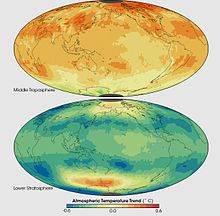
The division of the atmosphere into layers mostly by reference to temperature is discussed above. Temperature decreases with altitude starting at sea level, but variations in this tendency begin above 11 km, where the temperature stabilizes over a large vertical altitude through the rest of the troposphere. In the stratosphere, starting higher up about xx km, the temperature increases with height, due to heating inside the ozone layer acquired past the capture of significant ultraviolet radiation from the Lord's day by the dioxygen and ozone gas in this region. However another region of increasing temperature with altitude occurs at very loftier altitudes, in the aptly-named thermosphere in a higher place 90 km.
Speed of audio
Because in an ideal gas of abiding limerick the speed of sound depends only on temperature and not on pressure or density, the speed of sound in the temper with altitude takes on the class of the complicated temperature profile (see illustration to the correct), and does not mirror altitudinal changes in density or pressure.
Density and mass

Temperature and mass density against altitude from the NRLMSISE-00 standard atmosphere model (the eight dotted lines in each "decade" are at the eight cubes 8, 27, 64, ..., 729)
The density of air at sea level is about 1.2 kg/m3 (i.two g/L, 0.0012 g/cm3). Density is not measured directly but is calculated from measurements of temperature, pressure level and humidity using the equation of state for air (a form of the platonic gas constabulary). Atmospheric density decreases as the distance increases. This variation tin exist approximately modeled using the barometric formula. More sophisticated models are used to predict the orbital decay of satellites.
The average mass of the temper is about 5 quadrillion (5×10 15 ) tonnes or ane/1,200,000 the mass of Globe. Co-ordinate to the American National Center for Atmospheric Inquiry, "The full mean mass of the atmosphere is five.1480×10 18 kg with an annual range due to water vapor of 1.2 or i.5×x 15 kg, depending on whether surface pressure or water vapor data are used; somewhat smaller than the previous guess. The mean mass of water vapor is estimated equally 1.27×10 xvi kg and the dry air mass equally 5.1352 ±0.0003×10 eighteen kg."
Optical properties
Solar radiation (or sunlight) is the energy Earth receives from the Sun. Earth also emits radiations back into space, but at longer wavelengths that humans cannot see. Role of the incoming and emitted radiations is absorbed or reflected by the atmosphere. In May 2017, glints of lite, seen as twinkling from an orbiting satellite a meg miles away, were establish to be reflected light from ice crystals in the atmosphere.[41] [42]
Scattering
When light passes through Globe's atmosphere, photons interact with it through scattering. If the light does not interact with the atmosphere, it is called direct radiations and is what you lot see if you were to look straight at the Sunday. Indirect radiations is light that has been scattered in the temper. For example, on an overcast twenty-four hour period when you cannot see your shadow, in that location is no direct radiation reaching you, it has all been scattered. Every bit another example, due to a phenomenon called Rayleigh scattering, shorter (bluish) wavelengths scatter more easily than longer (red) wavelengths. This is why the sky looks blueish; you are seeing scattered blue light. This is also why sunsets are crimson. Because the Sun is close to the horizon, the Sunday's rays pass through more than temper than normal before reaching your eye. Much of the blue light has been scattered out, leaving the reddish light in a sunset.
Assimilation
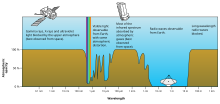
Rough plot of Earth's atmospheric transmittance (or opacity) to various wavelengths of electromagnetic radiation, including visible lite.
Different molecules blot different wavelengths of radiation. For case, Otwo and O3 absorb about all radiation with wavelengths shorter than 300 nanometers. Water (HtwoO) absorbs at many wavelengths in a higher place 700 nm. When a molecule absorbs a photon, information technology increases the energy of the molecule. This heats the atmosphere, just the temper as well cools by emitting radiations, equally discussed below.
The combined absorption spectra of the gases in the temper leave "windows" of low opacity, assuasive the transmission of only sure bands of light. The optical window runs from around 300 nm (ultraviolet-C) up into the range humans tin can see, the visible spectrum (unremarkably called low-cal), at roughly 400–700 nm and continues to the infrared to around 1100 nm. There are also infrared and radio windows that transmit some infrared and radio waves at longer wavelengths. For case, the radio window runs from about one centimeter to almost 11-meter waves.
Emission
Emission is the reverse of absorption, it is when an object emits radiation. Objects tend to emit amounts and wavelengths of radiations depending on their "black body" emission curves, therefore hotter objects tend to emit more radiation, with shorter wavelengths. Colder objects emit less radiation, with longer wavelengths. For example, the Dominicus is approximately half dozen,000 G (v,730 °C; ten,340 °F), its radiation peaks nigh 500 nm, and is visible to the human middle. Earth is approximately 290 Thousand (17 °C; 62 °F), so its radiation peaks nearly 10,000 nm, and is much as well long to be visible to humans.
Considering of its temperature, the temper emits infrared radiation. For instance, on clear nights Earth's surface cools down faster than on cloudy nights. This is because clouds (H2O) are strong absorbers and emitters of infrared radiation. This is likewise why it becomes colder at night at college elevations.
The greenhouse outcome is directly related to this absorption and emission upshot. Some gases in the atmosphere absorb and emit infrared radiation, but practise not interact with sunlight in the visible spectrum. Common examples of these are CO2 and HiiO.
Refractive index

The refractive alphabetize of air is close to, but just greater than one. Systematic variations in the refractive index tin can lead to the bending of light rays over long optical paths. One example is that, under some circumstances, observers onboard ships can see other vessels just over the horizon because lite is refracted in the same direction as the curvature of Earth'southward surface.
The refractive index of air depends on temperature,[43] giving rising to refraction effects when the temperature gradient is big. An example of such effects is the mirage.
Circulation
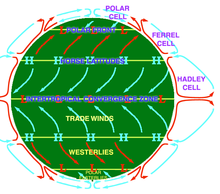
An idealised view of three pairs of large circulation cells.
Atmospheric circulation is the big-scale movement of air through the troposphere, and the ways (with ocean circulation) past which estrus is distributed around Earth. The big-scale structure of the atmospheric circulation varies from yr to year, but the basic structure remains adequately constant considering it is adamant by Earth'southward rotation rate and the difference in solar radiation between the equator and poles.
Evolution of Earth'south atmosphere
Earliest temper
The start atmosphere consisted of gases in the solar nebula, primarily hydrogen. In that location were probably unproblematic hydrides such as those now establish in the gas giants (Jupiter and Saturn), notably water vapor, methane and ammonia.[44]
Second atmosphere
Outgassing from volcanism, supplemented by gases produced during the late heavy bombardment of Earth by huge asteroids, produced the side by side atmosphere, consisting largely of nitrogen plus carbon dioxide and inert gases.[44] A major part of carbon-dioxide emissions dissolved in water and reacted with metals such every bit calcium and magnesium during weathering of crustal rocks to form carbonates that were deposited as sediments. Water-related sediments have been found that date from as early on every bit three.viii billion years ago.[45]
Near 3.4 billion years ago, nitrogen formed the major role of the then stable "second temper". The influence of life has to be taken into account rather before long in the history of the atmosphere because hints of early life-forms announced as early as 3.5 billion years ago.[46] How Earth at that time maintained a climate warm enough for liquid water and life, if the early Sun put out xxx% lower solar radiance than today, is a puzzle known equally the "faint immature Sun paradox".
The geological record however shows a continuous relatively warm surface during the complete early temperature tape of Earth – with the exception of one cold glacial phase about 2.iv billion years agone. In the late Archean Eon an oxygen-containing atmosphere began to develop, apparently produced by photosynthesizing cyanobacteria (see Great Oxygenation Outcome), which accept been found as stromatolite fossils from 2.7 billion years ago. The early basic carbon isotopy (isotope ratio proportions) strongly suggests conditions like to the current, and that the fundamental features of the carbon cycle became established as early on as 4 billion years ago.
Ancient sediments in the Gabon dating from between about two.xv and ii.08 billion years agone provide a tape of Globe'southward dynamic oxygenation evolution. These fluctuations in oxygenation were probable driven by the Lomagundi carbon isotope excursion.[47]
Third temper
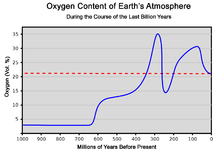
Oxygen content of the atmosphere over the last billion years[48] [49]
The constant re-system of continents by plate tectonics influences the long-term evolution of the temper by transferring carbon dioxide to and from large continental carbonate stores. Free oxygen did not exist in the atmosphere until most two.four billion years ago during the Great Oxygenation Effect and its advent is indicated by the end of the banded fe formations.
Earlier this fourth dimension, any oxygen produced by photosynthesis was consumed by the oxidation of reduced materials, notably iron. Complimentary oxygen molecules did not beginning to accrue in the temper until the rate of production of oxygen began to exceed the availability of reducing materials that removed oxygen. This point signifies a shift from a reducing atmosphere to an oxidizing atmosphere. O2 showed major variations until reaching a steady state of more than 15% by the end of the Precambrian.[50] The following time span from 539 million years ago to the present twenty-four hour period is the Phanerozoic Eon, during the earliest period of which, the Cambrian, oxygen-requiring metazoan life forms began to appear.
The amount of oxygen in the temper has fluctuated over the last 600 one thousand thousand years, reaching a elevation of about 30% effectually 280 million years ago, significantly higher than today's 21%. Two main processes govern changes in the atmosphere: Plants using carbon dioxide from the atmosphere and releasing oxygen, and then plants using some oxygen at dark by the process of photorespiration while the remaining oxygen is used to break downward organic material. Breakdown of pyrite and volcanic eruptions release sulfur into the temper, which reacts with oxygen and hence reduces its corporeality in the atmosphere. However, volcanic eruptions also release carbon dioxide, which plants can convert to oxygen. The cause of the variation of the amount of oxygen in the temper is not known. Periods with much oxygen in the temper are associated with the rapid evolution of animals because oxygen is the high-energy molecule needed to power all circuitous life-forms.[51] Today's temper contains 21% oxygen, which is keen enough for this rapid development of animals.[52]
Air pollution
Air pollution is the introduction into the atmosphere of chemicals, particulate affair or biological materials that cause harm or discomfort to organisms.[53] Stratospheric ozone depletion is caused by air pollution, chiefly from chlorofluorocarbons and other ozone-depleting substances.
Since 1750, human activity has increased the concentrations various greenhouse gases, most importantly carbon dioxide, methane and nitrous oxide. This increase has caused an observed rise in global temperatures. Global average surface temperatures were 1.1 °C higher in the 2011-2020 decade than they were in 1850.[54]
Blitheness shows the buildup of tropospheric CO2 in the Northern Hemisphere with a maximum around May. The maximum in the vegetation cycle follows in the belatedly summer. Following the peak in vegetation, the drawdown of atmospheric CO2 due to photosynthesis is apparent, particularly over the boreal forests.
Images from space
On October 19, 2015, NASA started a website containing daily images of the full sunlit side of World at https://epic.gsfc.nasa.gov/. The images are taken from the Deep Space Climate Observatory (DSCOVR) and show World equally it rotates during a 24-hour interval.[55]
-

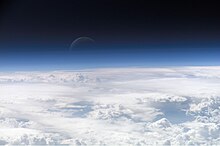
Limb view, of Earth's atmosphere. Colors roughly announce the layers of the temper.
-

This epitome shows the Moon at the centre, with the limb of Earth well-nigh the bottom transitioning into the orange-colored troposphere. The troposphere ends abruptly at the tropopause, which appears in the image as the sharp boundary between the orange- and bluish-colored atmosphere. The silvery-blue noctilucent clouds extend far in a higher place Globe's troposphere.
See besides
- Aerial perspective
- Air (classical element)
- Air glow
- Airshed
- Atmospheric dispersion modeling
- Atmospheric electricity
- Atmospheric Radiation Measurement Climate Research Facility (ARM) (in the U.S.)
- Atmospheric stratification
- Biosphere
- Climate organization
- Earth'due south energy upkeep
- COSPAR international reference atmosphere (CIRA)
- Environmental impact of aviation
- Global dimming
- Historical temperature tape
- Hydrosphere
- Hypermobility (travel)
- Kyoto Protocol
- Leaching (agriculture)
- Lithosphere
- Reference atmospheric model
References
- ^ "Gateway to Astonaut Photos of Earth". NASA. Retrieved 2018-01-29 .
- ^ a b "Trends in Atmospheric Carbon Dioxide", Global Greenhouse Gas Reference Network, NOAA, 2019, retrieved 2019-05-31
- ^ a b "Trends in Atmospheric Methane", Global Greenhouse Gas Reference Network, NOAA, 2019, retrieved 2019-05-31
- ^ a b Haynes, H. Thou., ed. (2016–2017), CRC Handbook of Chemistry and Physics (97th ed.), CRC Press, p. 14-iii, ISBN978-1-4987-5428-vi , which cites Allen's Astrophysical Quantities but includes but ten of its largest constituents.
- ^ Cox, Arthur Due north., ed. (2000), Allen'due south Astrophysical Quantities (Fourth ed.), AIP Press, pp. 258–259, ISBN0-387-98746-0 , which rounds Due northtwo and O2 to four meaning digits without affecting the total because 0.004% was removed from Northwardtwo and added to Otwo. Information technology includes 20 constituents.
- ^ National Aeronautics and Space Assistants (1976), U.South. Standard Atmosphere, 1976 (PDF), p. 3
- ^ Allen, C. W. (1976), Astrophysical Quantities (Third ed.), Athlone Press, p. 119, ISBN0-485-11150-0
- ^ a b Two recent reliable sources cited here take total atmospheric compositions, including trace molecules, that exceed 100%. They are Allen'southward Astrophysical Quantities [v] (2000, 100.001241343%) and CRC Handbook of Chemistry and Physics [four] (2016–2017, 100.004667%), which cites Allen'south Astrophysical Quantities. Both are used equally references in this article. Both exceed 100% because their CO2 values were increased to 345 ppmv, without changing their other constituents to compensate. This is made worse by the April 2019 COtwo value, which is 413.32 ppmv.[2] Although minor, the January 2019 value for CHiv is 1866.1 ppbv (parts per billion).[3] Two older reliable sources have dry atmospheric compositions, including trace molecules, that total less than 100%: U.S. Standard Atmosphere, 1976 [half dozen] (99.9997147%); and Astrophysical Quantities [7] (1976, 99.9999357%).
- ^ Lide, David R. Handbook of Chemistry and Physics. Boca Raton, FL: CRC, 1996: xiv–17
- ^ Vázquez, M.; Hanslmeier, A. (2006). "Historical Introduction". Ultraviolet Radiations in the Solar System. Astrophysics and Space Science Library. Vol. 331. Springer Science & Business Media. p. 17. Bibcode:2005ASSL..331.....V. doi:10.1007/1-4020-3730-9_1. ISBN978-1-4020-3730-6.
- ^ a b Wallace, John Thousand. and Peter V. Hobbs. Atmospheric Science: An Introductory Survey Archived 2018-07-28 at the Wayback Automobile. Elsevier. Second Edition, 2006. ISBN 978-0-12-732951-2. Chapter 1
- ^ "Trace Gases". Ace.mmu.air conditioning.uk. Archived from the original on 9 October 2010. Retrieved 2010-x-16 .
- ^ "Vital signs: Carbon Dioxide". NASA Climate. April 2022. Retrieved 16 May 2022.
- ^ Detlev Möller: Luft: Chemie, Physik, Biologie, Reinhaltung, Recht. Walter de Gruyter, 2003, ISBN 3-11-016431-0, S. 173. (View in Google Books).
- ^ Yunus Çengel. Termodinamica e trasmissione del calore.
- ^ "Air - Molecular Weight and Composition". www.engineeringtoolbox.com . Retrieved 2021-04-27 .
- ^ "Air Composition". The Applied science ToolBox. Retrieved 2017-07-04 .
The composition of air is unchanged until peak of approximately 10.000 m
- ^ "Exosphere - overview". UCAR. 2011. Archived from the original on 17 May 2017. Retrieved April nineteen, 2015.
- ^ Zell, Holly (2015-03-02). "Earth's Upper Atmosphere". NASA . Retrieved 2017-02-twenty .
- ^ a b "Exosphere - overview". UCAR. 2011. Archived from the original on 17 May 2017. Retrieved April 19, 2015.
- ^ a b Randy Russell (2008). "The Thermosphere". Retrieved 2013-x-18 .
- ^ a b "The acme of the tropopause". Das.uwyo.edu. Retrieved 2012-04-18 .
- ^ Ahrens, C. Donald. Essentials of Meteorology. Published by Thomson Brooks/Cole, 2005.
- ^ States, Robert J.; Gardner, Chester S. (January 2000). "Thermal Structure of the Mesopause Region (fourscore–105 km) at 40°N Latitude. Role I: Seasonal Variations". Journal of the Atmospheric Sciences. 57 (1): 66–77. Bibcode:2000JAtS...57...66S. doi:10.1175/1520-0469(2000)057<0066:TSOTMR>2.0.CO;2.
- ^ Joe Buchdahl. "Atmosphere, Climate & Surround Information Programme". Ace.mmu.air-conditioning.uk. Archived from the original on 2010-07-01. Retrieved 2012-04-eighteen .
- ^ Journal of the Atmospheric Sciences (1993). "stratopause". Retrieved 2013-10-eighteen .
- ^ Barry, R.G.; Chorley, R.J. (1971). Temper, Weather and Climate . London: Menthuen & Co Ltd. p. 65. ISBN9780416079401.
- ^ Tyson, P.D.; Preston-Whyte, R.A. (2013). The Weather and Climate of Southern Africa (2nd ed.). Oxford: Oxford Academy Press. p. 4.
- ^ "Troposphere". Curtailed Encyclopedia of Scientific discipline & Technology. McGraw-Hill. 1984.
It contains almost iv-fifths of the mass of the whole temper.
- ^ "ISS022-E-062672 explanation". NASA. Archived from the original on xvi February 2010. Retrieved 21 September 2012.
- ^ "homosphere – AMS Glossary". Amsglossary.allenpress.com. Archived from the original on 14 September 2010. Retrieved 2010-10-16 .
- ^ "World's Atmosphere". Archived from the original on 2009-06-14.
- ^ "NASA – Earth Fact Canvas". Nssdc.gsfc.nasa.gov. Archived from the original on 30 Oct 2010. Retrieved 2010-ten-16 .
- ^ "Global Surface Temperature Anomalies". Archived from the original on 2009-03-03.
- ^ "Globe's Radiation Balance and Oceanic Heat Fluxes". Archived from the original on 2005-03-03.
- ^ "Coupled Model Intercomparison Project Control Run" (PDF). Archived from the original (PDF) on 2008-05-28.
- ^ Geometric distance vs. temperature, pressure, density, and the speed of audio derived from the 1962 U.Southward. Standard Atmosphere.
- ^ Trenberth, Kevin Due east.; Smith, Lesley (1970-01-01). "The Mass of the Temper: A Constraint on Global Analyses". Journal of Climate. xviii (vi): 864. Bibcode:2005JCli...18..864T. CiteSeerX10.one.1.727.6573. doi:10.1175/JCLI-3299.ane. S2CID 16754900.
- ^ Lutgens, Frederick K. and Edward J. Tarbuck (1995) The Temper, Prentice Hall, 6th ed., pp. xiv–17, ISBN 0-13-350612-half dozen
- ^ "Atmospheric Temperature Trends, 1979–2005 : Epitome of the Day". Earthobservatory.nasa.gov. 2000-01-01. Retrieved 2014-06-x .
- ^ St. Fleur, Nicholas (19 May 2017). "Spotting Mysterious Twinkles on Earth From a Million Miles Away". The New York Times . Retrieved 20 May 2017.
- ^ Marshak, Alexander; Várnai, Tamás; Kostinski, Alexander (15 May 2017). "Terrestrial glint seen from deep space: oriented ice crystals detected from the Lagrangian point". Geophysical Research Messages. 44 (10): 5197. Bibcode:2017GeoRL..44.5197M. doi:10.1002/2017GL073248.
- ^ Edlén, Bengt (1966). "The refractive index of air". Metrologia. two (2): 71–80. Bibcode:1966Metro...2...71E. doi:x.1088/0026-1394/2/2/002.
- ^ a b Zahnle, K.; Schaefer, L.; Fegley, B. (2010). "Earth's Earliest Atmospheres". Cold Leap Harbor Perspectives in Biology. 2 (x): a004895. doi:x.1101/cshperspect.a004895. PMC2944365. PMID 20573713.
- ^ B. Windley: The Evolving Continents. Wiley Press, New York 1984
- ^ J. Schopf: Earth's Earliest Biosphere: Its Origin and Evolution. Princeton University Press, Princeton, North.J., 1983
- ^ Timothy W. Lyons, Christopher T. Reinhard & Noah J. Planavsky (2014). "Atmospheric oxygenation three billion years ago". Nature. 506 (7488): 307–xv. Bibcode:2014Natur.506..307L. doi:ten.1038/nature13068. PMID 24553238. S2CID 4443958.
- ^ Martin, Daniel; McKenna, Helen; Livina, Valerie (2016). "The human physiological impact of global deoxygenation". The Journal of Physiological Sciences. 67 (one): 97–106. doi:10.1007/s12576-016-0501-0. ISSN 1880-6546. PMC5138252. PMID 27848144.
- ^ Graph: Atmospheric Oxygen and CO2 vs Time
- ^ Christopher R. Scotese, Back to Earth History : Summary Chart for the Precambrian, Paleomar Project
- ^ Schmidt-Rohr, K. (2020). "Oxygen Is the Loftier-Free energy Molecule Powering Complex Multicellular Life: Fundamental Corrections to Traditional Bioenergetics". ACS Omega 5: 2221-2233. http://dx.doi.org/10.1021/acsomega.9b03352
- ^ Peter Ward:[ane] Out of Thin Air: Dinosaurs, Birds, and Earth's Ancient Temper
- ^ Starting from [2] Pollution – Definition from the Merriam-Webster Online Lexicon
- ^ IPCC (2021). "Summary for Policymakers" (PDF). IPCC AR6 WG1. pp. 4–5. Archived from the original (PDF) on 2021-08-11. Retrieved 2021-11-20 .
- ^ Northon, Karen (2015-10-19). "Daily Views of Earth Available on New NASA Website". NASA . Retrieved 2015-10-21 .
External links
 | Wikiquote has quotations related to Air . |
- Interactive global map of current atmospheric and ocean surface conditions.
Source: https://en.wikipedia.org/wiki/Atmosphere_of_Earth
Posted by: gilmorenarvir.blogspot.com
0 Response to "What Is The Makeup Of The Atmosphere And Air Pressure"
Post a Comment